A company in China is using artificial intelligence to make education more accessible for children with autism. Our Chen Mengfei visits a school in central China to see how the technology is helping to bridge the gap.
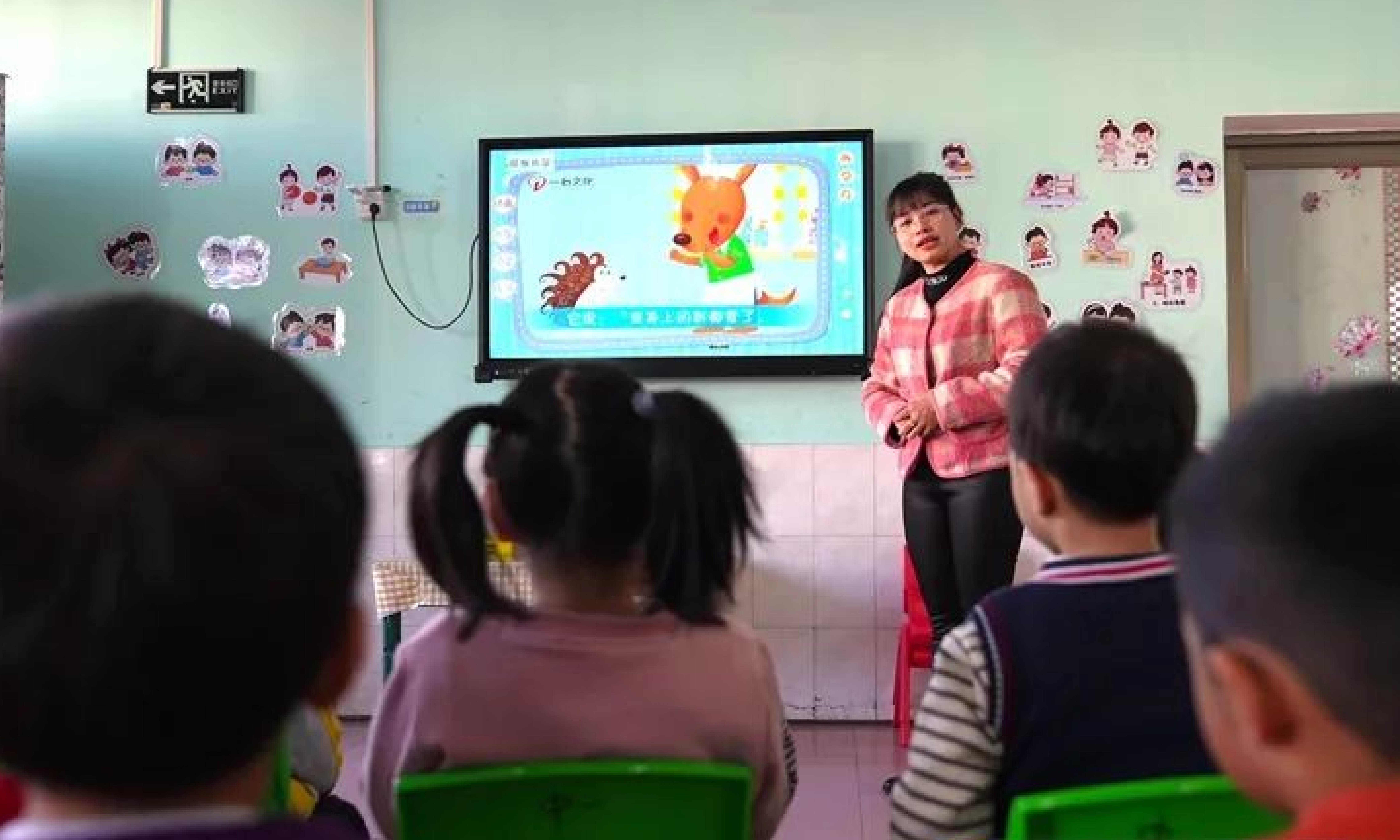
In a quiet corner of Pingdingshan, it's class time for four-year-old Lingling. While most children her age can be already quite chatty, Lingling still struggles to form basic syllables.
"Eat chips."
Difficulty with speech is just one of many challenges for Lingling, who has autism spectrum disorder. She is one of millions in China. Like so many others, the condition is deeply frustrating, and often leaves her on the margins of society.
Now, Lingling takes lessons at a local autism rehabilitation center. The exact cause of autism, not to mention, a so-called cure, remains a mystery. But therapies like this have proven helpful. And lately, her family has noticed a significant change.
LINGLING'S MOM "She used to hate these classes. She would cry throughout the 30-minute session. But since she started taking this new class, I've noticed she really enjoys it. She's happy."
The new class is called RICE AI, named after the software the school recently adopted. Lingling's teacher, Ren Xiaojuan, uses it to plan lessons, track progress, and get new ideas.
Reporter "So RICE AI suggested using bubbles to you?"
Ren Xiaojuan "Yes, exactly! This is what RICE AI does very well."
Even with 20 years of experience, Ren Xiaojuan is amazed by the AI's guidance.
REN XIAOJUAN, Head Teacher, Pingdingshan Sunflower Children's Development Center "The curriculum designed by RICE AI has a clear focus. That is, we shouldn't teach children the way we train animals. Especially children with autism. They should be treated as people. The teaching happens through games and activities, and children make rapid progress."
Even in the digital age, the knowledge gap between smaller cities and top-tier cities can be stark. More than 1,000 kilometers from Pingdingshan, where Lingling and teacher Ren live, is the team behind RICE AI in Shenzhen—China's "Silicon Valley." The company operates a nationwide network of autism intervention centers. To train its teachers, it has experts like Dr. Zheng Tian.
ZHENG TIAN, Chief Training Supervisor, Dami & Xiaomi "My official title is a Board-Certified Behavior Analyst at the doctoral level (BCBA-D).
She's one of just three senior supervisors at the company with those credentials. Across China, specialists at this level are even more rare, compared to millions in need. The company has long wanted to capture and scale the expertise of people like Zheng, but lacked the technology until the arrival of the AI boom.
CUI QIAN, Chief Technology Officer, Dami & Xiaomi "When DeepSeek came out, we realized that we finally had access to a really strong open-source model. In addition, companies like Amazon provided the technical support we needed."
All was in place, and the final piece of the puzzle was the company's own invaluable data. Real-world records teaching some 30,000 students, accumulated over a decade.
With parents' consent, this data was fed to the AI, and it learned to make decisions and offer suggestions just like a human supervisor. As the company hoped, all that expertise is now finally reaching those who once had no access to it.
Back in Pingdingshan, teacher Ren is hosting a weekly meeting on using the tool. One colleague recommends the picture book function. A student couldn't help but pulling out her hair in class. So, the teacher asked AI to make a little story, featuring a little crow, the student's favorite animal, and her feathers.
Teacher "Her behavioral issues have decreased significantly."
Reporter "Wow that's amazing."
The AI system is a significant investment—but for the school's manager, it's proving worthwhile.
SONG WENTAO, Director, Pingdingshan Sunflower Children's Development Center "First, it has completely revolutionized our traditional approach to rehabilitation. Secondly, it is effectively raising the standard of care across our entire institution."
For teacher Ren, this job is personal. When she had fever as a child, her mother tried an unproven treatment that caused only pain, but no cure. Unfortunately, such suffering is still happening today.
REN XIAOJUAN, Head Teacher, Pingdingshan Sunflower Children's Development Center "Rehabilitation is a slow process, so parents turn to other methods they think might deliver faster results—acupuncture, medication, anything. Some of my current students are still receiving these treatments, and no matter what I tell their parents, they won't listen. This is especially common in underdeveloped cities like ours."
Teacher Ren says her ability to speak convinced her mom to stop. Something her students cannot do.
REN XIAOJUAN, Head Teacher, Pingdingshan Sunflower Children's Development Center "Once I told my mom she wasn't being nice, she never took me for acupuncture again. But these children can't speak, so the needles keep coming."
This deep empathy is what drives Ren to empower her students. Now, AI is helping her do that more effectively. Chen Mengfei, CGTN, Pingdingshan, Henan Province.